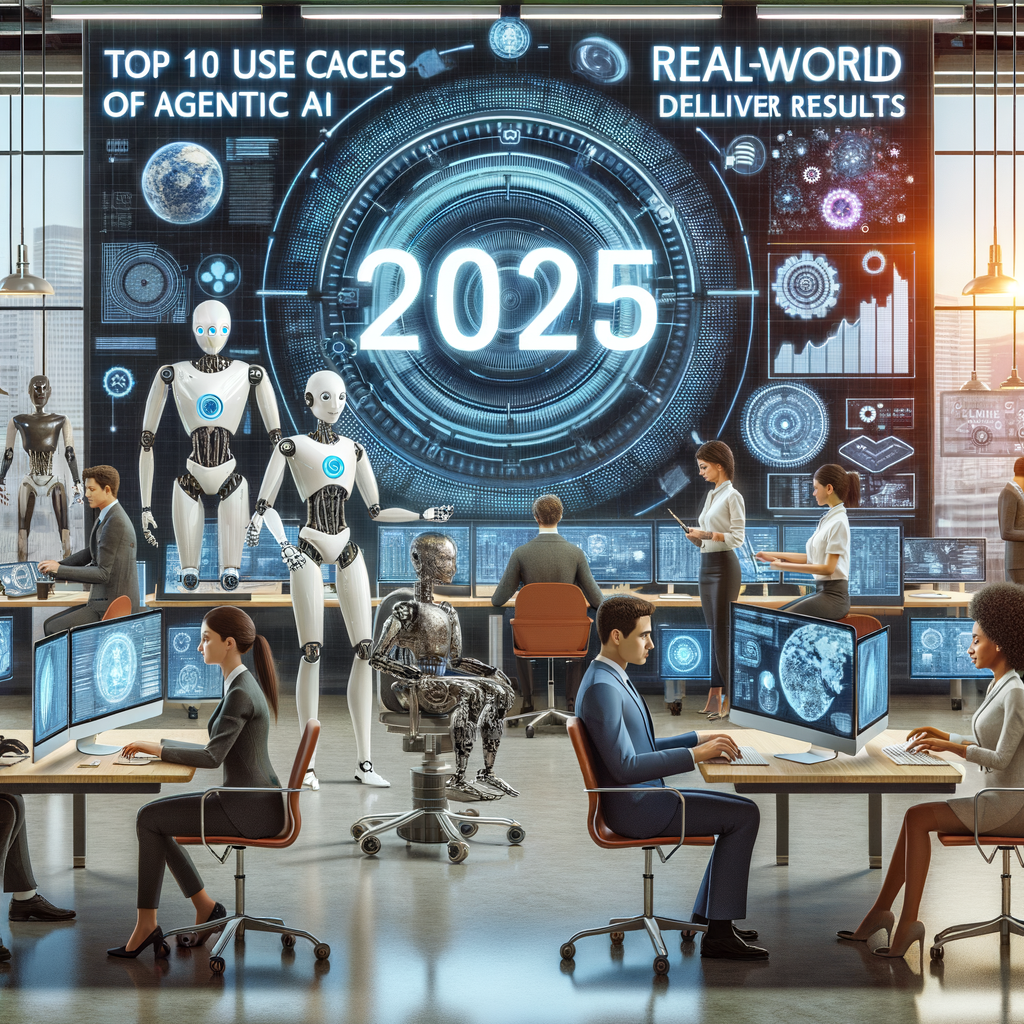
Top 10 Use Cases of Agentic AI in 2025: Real‑World Automation That Delivers Results
Agentic AI is rapidly transforming the landscape of automation, pushing the boundaries of what machines can autonomously achieve. By 2025, this sophisticated form of artificial intelligence will no longer be just a futuristic concept but a critical driver of innovation across industries. Unlike traditional AI systems that rely heavily on human input, agentic AI operates with greater autonomy, decision-making capabilities, and adaptability—essentially acting as intelligent agents that can perform complex tasks independently. This article explores the top 10 use cases of agentic AI in 2025, highlighting real-world applications where automation is delivering tangible results.
1. Autonomous Supply Chain Management
One of the most impactful applications of agentic AI is in supply chain management. By 2025, intelligent agents will monitor inventory levels, predict demand fluctuations, optimize delivery routes, and coordinate with suppliers in real time without human intervention. This autonomous orchestration reduces delays, cuts costs, and enhances responsiveness, enabling companies to adapt quickly to changing market conditions.
2. Personalized Healthcare Assistance
Agentic AI is revolutionizing healthcare by providing personalized care plans and proactive health monitoring. These AI agents analyze patient data continuously, anticipate potential health issues, and suggest preventative measures. From managing chronic diseases to scheduling treatments and medication, agentic AI assists both patients and medical professionals, improving outcomes and efficiency in the healthcare system.

3. Intelligent Financial Advisory Services
The financial industry is leveraging agentic AI for portfolio management and risk assessment. By 2025, AI agents will autonomously analyze market trends, evaluate investment risks, and execute trades aligned with client goals—all while adapting to shifting economic landscapes. This real-time financial decision-making capability empowers investors with smarter, faster, and more reliable advice.

4. Automated Legal Research and Contract Review
Agentic AI will significantly streamline legal operations by autonomously conducting research, analyzing case law, and reviewing contracts. These intelligent agents can identify critical clauses, flag potential risks, and ensure compliance with regulations. By automating routine legal tasks, law firms and corporate legal departments will save time and reduce errors, allowing attorneys to focus on strategy and client relationships.
5. Smart Manufacturing and Predictive Maintenance
In manufacturing, agentic AI will oversee entire production lines with minimal human oversight. These AI agents predict equipment failures before they occur, schedule maintenance autonomously, and adjust production processes to optimize efficiency. This proactive approach minimizes downtime, extends machine lifespan, and boosts overall productivity on the factory floor.
6. Enhanced Customer Service through AI Agents
Customer service is another domain ripe for agentic AI innovation. Autonomous AI agents will handle customer inquiries across multiple channels, from chatbots to voice assistants, resolving issues without escalation. They will learn from interactions to provide personalized, context-aware responses, improving customer satisfaction while reducing operational costs for businesses.
7. Dynamic Content Creation and Marketing Automation
Marketing teams will benefit from agentic AI that can create, test, and optimize content dynamically. These AI agents will autonomously generate blog posts, social media updates, and advertising campaigns tailored to target audiences. By continuously analyzing engagement data, agentic AI will adjust marketing strategies in real time, maximizing reach and conversion rates.
8. Urban Planning and Smart City Management
Agentic AI will play a critical role in urban development by managing traffic flows, energy consumption, and public safety autonomously. Intelligent agents will analyze vast datasets from sensors and IoT devices to optimize city infrastructure, reduce congestion, and respond swiftly to emergencies. This real-time adaptability makes cities more livable and sustainable.
9. Advanced Cybersecurity Defense
As cyber threats become increasingly sophisticated, agentic AI will provide autonomous threat detection and mitigation. These AI agents will continuously monitor networks, identify vulnerabilities, and respond to attacks without human delay. Their ability to learn from new threats in real time will enhance organizational security and resilience.
10. Autonomous Research and Development
In the realm of R&D, agentic AI will accelerate innovation by autonomously conducting experiments, analyzing results, and iterating on designs. Whether in pharmaceuticals, materials science, or technology development, these AI agents will reduce the time and cost associated with discovery and prototyping, unlocking new possibilities at an unprecedented pace.
Conclusion
The rise of agentic AI in 2025 marks a pivotal shift in automation, where intelligent agents operate with autonomy and adaptability across diverse sectors. From optimizing supply chains to enhancing personalized healthcare and securing digital environments, these applications are already delivering measurable benefits. As businesses and governments increasingly adopt agentic AI, we can expect continued improvements in efficiency, accuracy, and innovation—ushering in a new era of real-world automation that truly delivers results.